How guppies are named
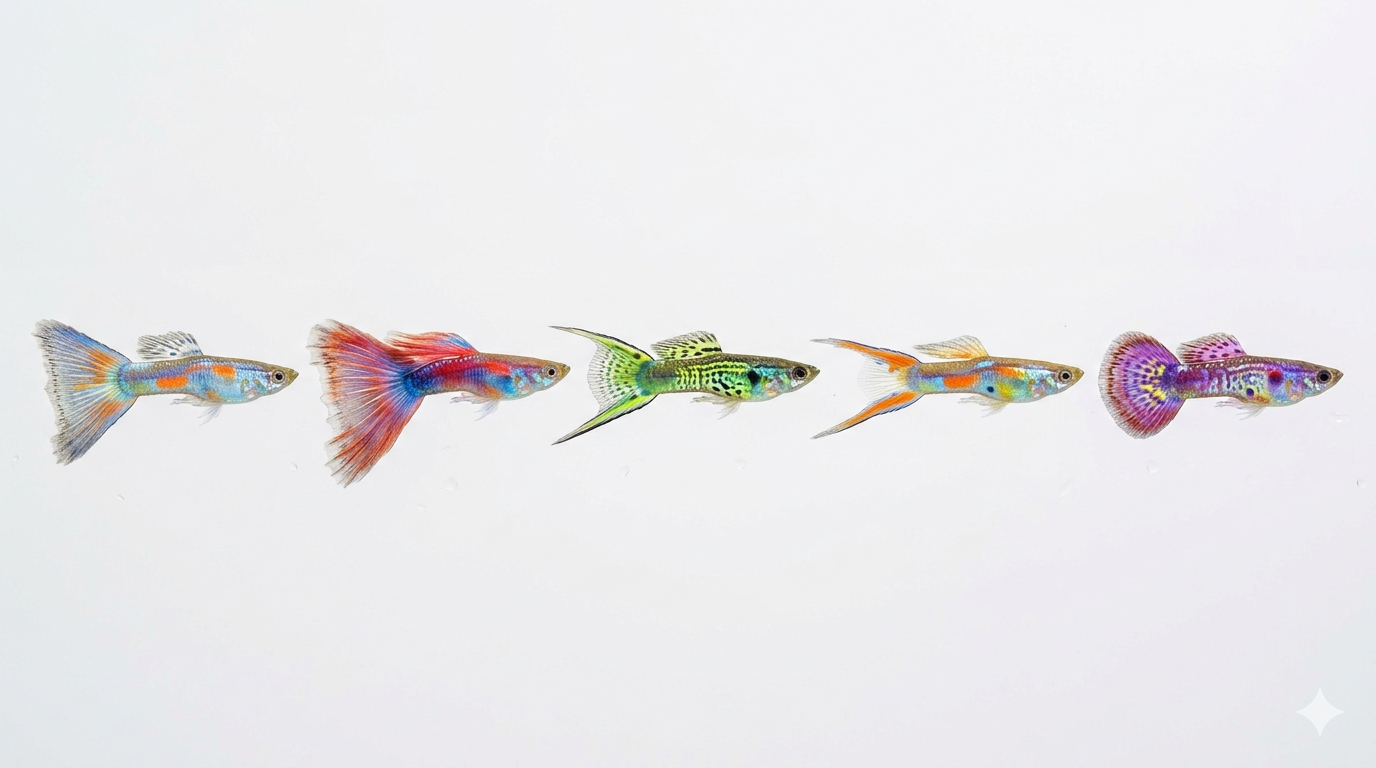
Every fancy guppy name is built from three parts: a colour class, a pattern, and a tail shape. Put them together and you get names like "Blue Delta" or "Half Black Red Delta".
The naming formula
colour class + pattern + tail shape
Read a guppy from front to back. First decide its sex, then judge the tail shape, then the dominant colour class, and finally any markings (the pattern). A "Yellow Cobra Delta" is a yellow fish with a cobra pattern and a delta tail. If a fish only has a half-black body and no markings, its pattern is simply "none".
Tail shapes — males
Males carry the large, flowing finnage that defines most show classes.
Tail shapes — females
Females are larger and drabber, with three recognised caudal shapes.
Colour classes — solids
A solid class is judged mostly on the caudal fin.
Colour classes — modifiers & specials
Half Black is a colour-class modifier (HB + colour), never a pattern.
Patterns
Patterns describe markings on the tail and body only.
Snakeskin
A rosette / chain-link mesh over the body and tail. Graded Solid vs Variegated.
Cobra
Vertical bars and spots together — a "cobra-hood" look on the body.
Mosaic
Irregular interlocking blotches of colour across the caudal.
Grass
Fine pepper-like dots that read as blades of grass in the fins.
Lace
A delicate fine-netted pattern, usually over a snakeskin base.
Leopard
Bold round spots resembling a leopard's rosettes.
Telling males from females
- Male: slim body, vivid colour, large flowing finnage, and a rod-like anal fin (the gonopodium).
- Female: larger and drabber, with a fan-shaped anal fin and often a dark gravid spot near the vent.
The IFGA standard
The International Fancy Guppy Association maintains the show standard that this naming system follows. It defines the recognised tail shapes, the colour classes and their thresholds (such as "≥51% red" for a Red class), and how patterns are judged. Guppy Time applies the same vocabulary so the names you get line up with what breeders and judges use.